
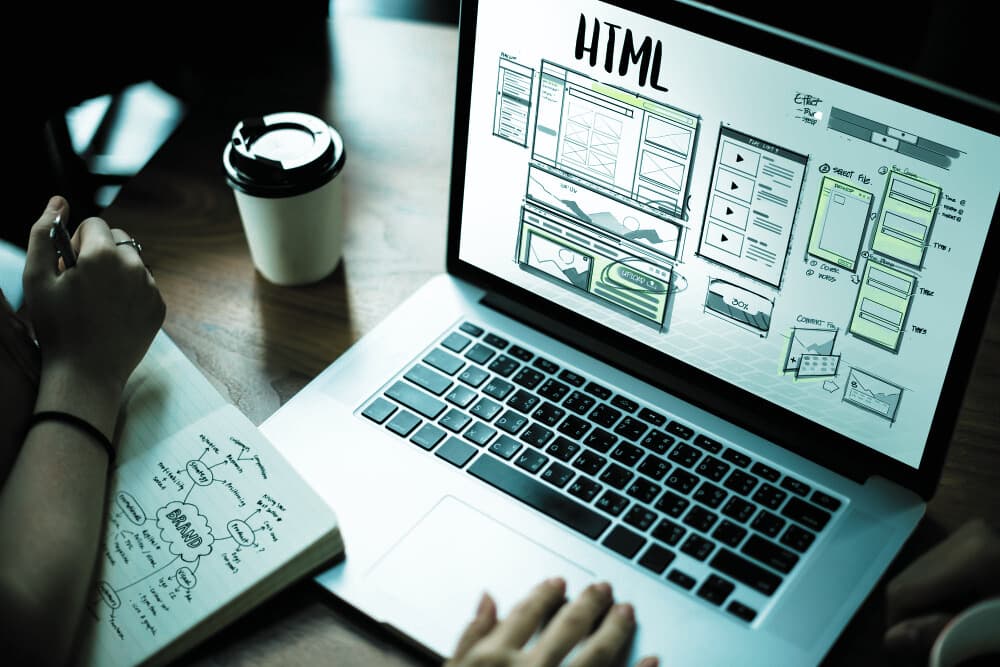
Creating a website is easy; the challenge is making it communicate exactly what you want to say. You can have text, images, and several sections, and still feel that your site doesn’t clearly express who you are or what you offer. Many brands experience the same issue: the information is there, but the narrative never fully comes together.
Web content is precisely what transforms that mix of elements into a coherent experience. When it’s well-thought-out, it guides the user, simplifies reading, and shapes your message.
In this article, I’ll explain what web content is, why it’s so important in digital communication, and which criteria you can apply to optimize it and build a clearer, stronger website aligned with your brand identity. Let’s begin.
What is web content?
Web content includes everything that appears on a page and conveys information to the user: the logo, images, text, menu, buttons, headings, videos, and even the order in which each section is presented.
Essentially, it’s the narrative structure that holds a page together. It gives meaning to each element and allows them to work collectively to communicate a clear message. In other words, it’s the combination of what you say, how you organize it, and the path you create for the user.
A well-structured website helps the user quickly understand who you are, what you offer, and how they can move forward. When content is disorganized or disconnected, the experience becomes confusing: the information exists, but it doesn’t guide.
Understanding what each part of your page communicates is the first step toward optimizing it and ensuring your site reflects your brand identity with precision and coherence.
Why is web content so important?
Every word, image, and narrative decision plays a role in the user experience. When content is well crafted, it transforms a static page into a clear and meaningful journey.
Here are some of the reasons why content matters:
- It gives intention and coherence
Just as we choose our words carefully when explaining something important, web content defines what you want to say, to whom, and in what way. It’s the foundation that supports your brand identity in the digital space.
- It guides the user through their journey
Well-structured content works as a guide that helps the user move from their initial question to the answer they’re looking for.
- It builds authority
When a brand communicates with clarity and confidence, it builds trust with the user. That’s why your content should demonstrate expertise and a solid understanding of your industry.
- It improves search visibility
The better you answer your audience’s questions, the more likely your page is to gain relevance on Google. Well-structured content that addresses real user needs ranks better and attracts more qualified traffic.
- It shapes the brand experience
How you communicate on your site creates an immediate impression: tone, clarity, structure, and style all contribute to the experience users associate with your brand. A consistent narrative conveys professionalism, identity, and attention to detail.
Types and formats of web content
Web content takes different forms depending on the function it serves. It’s not just about choosing a format, but understanding what each one contributes to the overall narrative. When these elements work together, the website becomes clearer, more consistent, and easier to navigate.
Here are the main types and formats you’ll find on a page:
This is the foundation of any website. It includes headings, subheadings, paragraphs, descriptions, FAQs, and microcopy (such as button or form text). Its purpose is to explain, guide, and give structure to the information.
Contributes:
- Tone of voice
- Conceptual clarity
- Order
- Hierarchy
- Narrative coherence
Images, illustrations, photographs, graphics, and banners. Visual elements are not decorative; they reinforce identity and improve comprehension. A well-chosen visual can communicate in seconds what text would take paragraphs to convey.
Contributes:
- Visual rhythm throughout the page
- Immediate context
- Style and personality
- Emotional or conceptual support
Institutional videos, demos, animations, tutorials, or testimonial videos. This format is ideal for explaining processes, showcasing dynamics, or conveying warmth and proximity.
Contributes:
- More dynamic experiences
- Higher retention
- Faster understanding of complex ideas
- Humanization of the brand
Elements that require user action: forms, sliders, calculators, filters, surveys, interactive maps, comparison tools. This type of content is especially useful in websites with products, services, or technical information.
Contributes:
- Better decision-making
- Active participation
- Personalization
- More intuitive navigation
Elements not always perceived as “content,” but essential to the experience: menus, breadcrumbs, buttons, internal links, icons, error pages, navigation labels.
Contributes:
- Reduced friction
- Orientation
- Accessibility
- Clear navigation paths
Anything that supports your claims: testimonials, client logos, seals, certifications, case studies.
Contributes:
- Social proof
- Credibility
- Authority
- Reduced uncertainty
Together, these formats build an integrated narrative: they inform, guide, show, validate, and support. The value lies in how they combine to express your brand identity and deliver a coherent user experience.
How to optimize your web content to appear in Google search?
Talking about web content inevitably means talking about search. Google operates like a giant question-and-answer system: someone asks something, and websites compete to offer the best response.
Optimizing content for SEO means helping Google understand that your answer is the most relevant for the user. The good news: you don’t need advanced technical skills to improve your site.

These are the simplest aspects you can work on to optimize your content:
1. Coherence
Your content must consistently reflect the main topic of the page. If you run an ecommerce store selling chainsaws, the page should naturally mention “chainsaws,” include product images, and offer a clear description. If you add user reviews or complementary information, even better. All of it reinforces the topic. The coherence between text, visuals, and purpose is one of the most important signals for Google.
2. Hierarchy
Headings (H1, H2, H3…) organize information and tell search engines what matters most. The H1 introduces the main topic and should include the primary keyword. For example, “Professional Chainsaws.” H2s divide main sections, and H3s expand on details.
3. Originality
Original content always has more value. It’s not only about avoiding copy-paste; it’s also about ensuring your explanations, examples, and visuals contribute something unique. If you use the same product photos as the manufacturer, it’s fine. But if you can add your own images or descriptions based on real experience, you create differentiation that Google recognizes.
4. Internal linking
A well-optimized site works like a network: each page connects logically to others. Internal linking helps the user move through the site, discover related content, and helps Google better understand the structure. Continuing with the example: if you sell chainsaws and also offer safety gloves, it’s best to keep both categories separated and include links that guide the user naturally from one to the other.
It may seem like a small adjustment, but a strong internal linking strategy is one of the most influential factors in SEO performance.
Frequently asked questions about web content
To wrap up, here are some of the questions our clients most often ask:
Conclusion
Web content is far more than information, it’s the narrative that holds your site together and shapes the user experience. When it’s well-structured and optimized, your website communicates clearly who you are and the value you offer. With what you’ve seen so far, you can already make meaningful improvements to your content. And if you want to take it to a more competitive level, I can help.
If you feel your content could be improved, a professional review can help you identify opportunities and guide your next steps. At Cyrano Contenidos, we offer free audits to evaluate your site and outline an optimization plan tailored to your needs and budget.
If you’d like to talk about your site or get an initial evaluation, feel free to reach out anytime. We’re here to support you.